
New York gives you options. So many options, in fact, that booking a flight can feel like trying to choose one bagel from a menu with 47 varieties.
JFK. Newark. LaGuardia. Nonstop. One stop. “Cheaper” fare that somehow adds six hours, two airport transfers, and a personal relationship with an airport charging station.
I’m Ayesha H, your NYC and Cruise Specialist, and I help travelers sort through the beautiful chaos of New York departures. As a local guide for NYC flight planning, I look beyond the first low fare and help you choose the airport, routing, seat, connection, and backup plan that actually fit your trip.
Because the cheapest flight is not always the cheapest trip.
Start With the Right NYC Airport
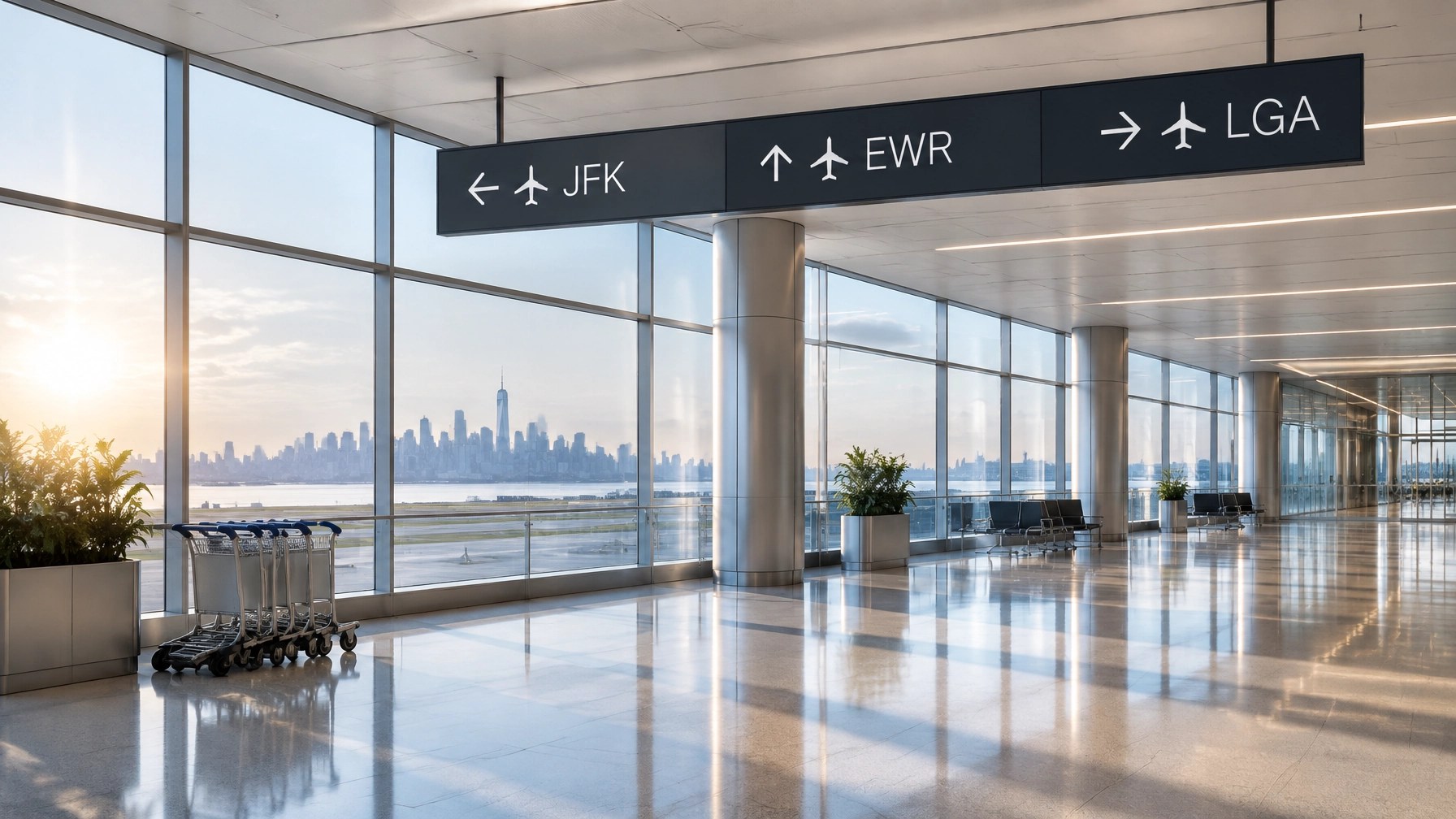
Choose JFK for long-haul and international flights
John F. Kennedy International Airport is usually your strongest option for:
- Europe
- Asia
- South America
- The Caribbean
- Long-haul international routes
- Many nonstop flights on major global airlines
JFK often gives you the best selection when you want to avoid a connection. That matters when you are flying across an ocean and would rather not add a bonus airport, a second security screening, and an unexpected sprint to Gate 92.
JFK can be a particularly good starting point for international trips where schedule choice matters. More departure times may give you better control over your arrival time, hotel check-in, cruise embarkation, or resort transfer.
Choose Newark for United-heavy routes and strong international schedules
Newark Liberty International Airport, or EWR, is often the better fit for:
- United Airlines travelers
- International flights
- Europe and long-haul routes
- Travelers based in New Jersey, western Connecticut, or parts of Manhattan
- Itineraries with convenient United connections
EWR can also be a smart choice for cruise travelers departing from New York or New Jersey, especially when the schedule works better with your pre-cruise hotel night.
Do not automatically assume JFK is better just because it is more famous. Airport loyalty is not a personality trait. Compare the full itinerary, your home location, traffic, and the airline schedule.
Choose LaGuardia for many domestic trips
LaGuardia Airport is often convenient for:
- Short domestic flights
- Northeast destinations
- Midwest routes
- Business travel
- Travelers staying in Manhattan or Queens
- Quick trips where proximity matters
LGA is generally focused on domestic and shorter-haul service. Its perimeter rules limit most nonstop flights beyond 1,500 miles, with exceptions such as Denver and certain Saturday flights. That is why LGA may be convenient for Chicago but not your best choice for a long international vacation.
For many domestic trips, LGA’s location can save time on the ground. But a cheaper ticket is not a bargain if getting to the airport turns your morning into an Olympic event involving traffic, tolls, and a suitcase wheel that suddenly chooses violence.
Nonstop Usually Wins, Especially for Long-Haul Travel
New York is one of the best places in the country to search for nonstop flights. Use that advantage.
A nonstop flight can mean:
- Less total travel time
- Fewer opportunities for delays
- No missed-connection domino effect
- Less chance of lost luggage
- Easier arrival-day planning
- More energy when you reach your destination
A one-stop itinerary may look cheaper by $100 or $200. But calculate the full cost:
- Airport meals during a long layover
- Extra baggage fees
- Ground transportation
- A missed hotel night
- Rebooking stress
- Lost vacation time
- The emotional price of eating a sandwich that costs $19 and tastes like a résumé
A connection can make sense when the savings are meaningful, the airport is easy to navigate, and the connection is comfortably timed. But for long-haul flights, I often recommend comparing the nonstop first, especially from JFK or EWR.
Avoid cross-airport “connections” whenever possible
A flight arriving at LaGuardia and departing from JFK is not a normal connection. It is a ground transfer wearing a flight itinerary costume.
According to the official JFK airport transfer guide, you may need to:
- Collect your checked bags.
- Travel to the second airport by car or public transportation.
- Check in again.
- Recheck your bags.
- Go through security again.
Traffic between JFK, EWR, and LGA can be unpredictable, especially during rush hour, holidays, rain, construction, or any weekday ending in “day.”
If an airport change is unavoidable, build in a generous buffer. For many travelers, that means several hours, not the 90-minute fantasy itinerary offered by a computer that has never dragged luggage through Queens.
When Should You Book, and When Should You Wait?
There is no single magic booking day. Anyone promising that every fare drops at 2:17 a.m. on a Tuesday is probably also selling a crystal ball.
For domestic flights
A practical starting point is:
- Book roughly one to three months ahead for many domestic trips.
- Book earlier for holidays, school breaks, major events, and popular nonstop routes.
- Consider midweek departures when your schedule allows.
- Compare JFK, EWR, and LGA, but do not sacrifice a nonstop just to save a small amount.
- Set fare alerts if your dates are flexible.
For popular domestic routes such as Los Angeles, Las Vegas, Florida, or major cruise departure cities, I prefer to monitor early and avoid waiting until the calendar starts looking nervous.
For international and long-haul flights
Plan farther ahead, especially when you need:
- Specific seats together
- Premium economy or business class
- A nonstop flight
- A family-friendly schedule
- A connection-free route
- Travel during holidays or peak seasons
- A flight that coordinates with a cruise departure
Waiting can occasionally pay off when your dates are flexible and you are willing to accept a connection, an inconvenient departure time, or a different airport. But if you need a specific nonstop or a comfortable seat for a 10-hour flight, waiting too long can leave you with the leftovers.
And nobody wants to begin a dazzling vacation in a middle seat between a snack bag and someone’s aggressively reclining elbow.
Long-Haul Flight Tips That Actually Help

Choose your seat before the plane chooses for you
For long flights:
- Select an aisle seat if you like to move, stretch, or access the restroom easily.
- Choose a window seat if you sleep better against the wall and want to control the shade.
- Avoid seats near galleys and lavatories if quiet matters to you.
- Check the aircraft map before paying for an upgrade.
- For families, confirm the seats are genuinely together, not “within the same general zip code.”
Seat maps can change, so I recommend checking the reservation again after booking and before departure.
Use upgrade strategies wisely
An upgrade is not always worth paying for, but it can make a major difference on an overnight or ultra-long-haul flight.
Consider:
- Premium economy for extra legroom and a wider seat
- Business class for lie-flat comfort on very long routes
- Using airline miles or points when the cash upgrade is unreasonable
- Watching for upgrade offers after ticketing
- Comparing the cost of upgrading one direction instead of both
- Prioritizing the overnight leg when you need to arrive rested
Sometimes the best value is not the cheapest business-class fare. It is upgrading the longest segment, choosing a better seat, or paying for comfort on the flight where sleep actually matters.
Give yourself a real connection buffer
For a domestic connection, avoid planning around the absolute minimum time shown in the search results. A longer buffer is especially important when:
- You are checking bags.
- You are traveling with children.
- You are changing terminals.
- You are flying during winter.
- You are connecting through a busy hub.
- You have a cruise, tour, or resort transfer waiting at the other end.
For international connections, allow extra time for security, passport control, terminal changes, and baggage rules. If your itinerary involves separate tickets, be even more cautious. Separate tickets may not offer the same protection if the first flight is delayed.
Prepare for Jet Lag Before You Board
Long-haul travel is much easier when you treat your body like a participant, not an underpaid employee being sent across the planet without notice.
Try to:
- Shift your bedtime gradually before departure.
- Hydrate throughout the flight.
- Limit alcohol, especially before sleeping.
- Move around periodically.
- Set your watch to the destination time after boarding.
- Seek daylight after arrival when appropriate.
- Keep the first day manageable instead of scheduling 14 activities before breakfast.
Pack the essentials in your carry-on:
- Medication
- Chargers
- A light layer
- Compression socks if recommended for you
- Toothbrush and basic toiletries
- Travel documents
- A change of clothes
- Anything you would be genuinely upset to lose in checked luggage
How AHTRAVELSNYC Helps Protect Your Trip
Searching flights online is easy. Choosing the right itinerary is where local know-how earns its keep.
As your NYC and Cruise Specialist, I can help you:
- Compare JFK, Newark, and LaGuardia
- Find nonstop options before settling for a connection
- Coordinate flights with cruise embarkation
- Review realistic connection times
- Identify airport and terminal changes
- Look for better seat options
- Compare premium cabin strategies
- Build in a pre-cruise hotel night when appropriate
- Plan for delays, tight schedules, and arrival-day logistics
- Review the details before you click “purchase”
I also help you avoid the classic mistakes: booking the wrong airport, choosing a connection that is technically possible but practically absurd, or saving $80 while adding half a day of unnecessary travel.
For more inspiration, explore AHTRAVELSNYC’s guide to where to stay in NYC before your cruise and then send me your trip details.
Ready to Book Smarter From New York?
Before you choose the lowest fare, send me your destination, dates, preferred airport, and priorities. Tell me whether you want the fastest route, the best value, the most comfortable seat, or a flight that keeps your cruise plans safely on track.
I’ll help you compare the options and choose a smarter way to travel from NYC, without making your vacation begin with an airport scavenger hunt.
Contact Ayesha H, your NYC and Cruise Specialist, at AHTRAVELSNYC to start planning.
Leave a Reply